

Remember Dr. McFillin from my July 26th post?
Well, guess what? He may not have “liked” my comment -- but he did the next best thing. He “liked” a reply to my post that thanked me for my insight and forthrightness. In other words, the doc may not be as bamboozled as I feared. Since then, my July 26th comment on the doctor’s substack has received another reply, asking me if I had tried tapering Effexor “hyperbolically.” I responded as follows.
“Yes. I had to pay for a compounding pharmacist. Even the compounding pharmacist could not give me extended release, because the manufacturer, Viatris, would not allow them to. I tapered EXTREMELY slowly and hyperbolically over the course of a year. It was more or less successful until the last month, when depression suddenly returned far worse than ever. It was overwhelming. I could scarcely move. The irony is that even these downsides could have been lived through had drug prohibition not prevented me from using substances like laughing gas on a symptomatic basis. So first drug prohibition shunts me off onto dependence-causing meds by outlawing near panaceas; then it outlaws the drugs that could help me get OFF those “meds.”
NOTE: I am not 100% sure of the current status of laughing gas in U.S. law. Of course, I could find out in an instant, no doubt, by Googling the matter or asking AI, but I am allergic to the kind of hysterical claptrap that such searches always bring up. What I’m saying here is that, technically speaking, laughing gas may not be totally outlawed in the U.S., but that it remains, as always, shamefully unavailable, as a practical matter, for the depressed -- to say nothing of the philosophers who wish to follow in the footsteps of William James. The irony here is that the drug prohibitionists fear the drug’s misuse, and yet it is precisely the outlawing (or at least the demonization) of such substances that make them dangerous, by forcing would-be users to become DIY chemists in order to access the substance on a practical basis.
MEDS V DRUGS: This is not the first time that I have found reason to mention Dr. McFillin in my essays. Three years ago, in July 2023, I referenced the doctor in an essay called "Doping Arizona", in which I objected to the FDA’s approval of an antidepressant called Lexapro for kids. For kids! Dr. McFillin was on the right side of that specific issue, for which I am grateful. But as is the case with his recent Substack post about the value of therapy, he holds in disdain not simply antidepressants, but drug therapies in general, and not just for kids, but for adults as well. This is a premature aversion, to put it mildly, considering how little Americans know about the psychoactive substances with which it turns out that the world is full. Armed with preconceptions only (preconceptions foisted upon us by drug war propaganda and the censorship of all instances of beneficial drug use) Americans refuse to contemplate the possibility of psychologically obvious drug protocols, like using nitrous oxide to keep the suicidal from killing themselves. So, while I generally agree that drug use should be limited to grown-ups, even that dictum should be a guideline and not a rule. If my child were going to kill him or herself because of gloom or deep despair, I would want them to use drugs that inspire and elate. Yes, I know it’s odd, isn’t it? I just happen to think that it’s better for children to be alive and use drugs than to go to their premature graves as sober as a judge.
Do our doctors really think that indigenous communities, at least as ideally conceived, would refuse a lifesaving treatment to a young person simply because he or she was too young to receive it according to some general rule?
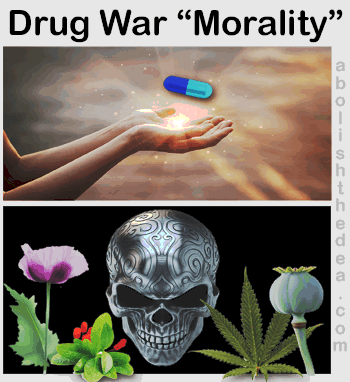
It’s odd, in a way. In one important sense, “meds” and “drugs” are exactly the same. They are both psychoactive substances — and the names of the categories in which we place them are simply part of a branding operation: those names provide “spin” as to how we are supposed to feel about the substances thus denominated. But in another way, “meds” and “drugs” are quite different things. “Meds” are substances for which dependency is a feature and which are said to “fix” a problem rather than to treat it symptomatically. “Drugs” are substances for which dependency is a mere bug and which work by alleviating the downsides of the human condition in real-time — rather than attempting to remove those downsides from the human condition altogether by biochemical means based on the notion that we are all chemical widgets amenable to the self-same interventions.
And so doctors like Mr. McFillin throw the baby out with the bathwater when they conclude that drugs are useless merely because “meds” have proven to be so. (Indeed, “meds” have been proven to be far worse than useless.) But the fact is that we scarcely know anything about drugs as a people. Our media has seen to that. And yet those of us who have read the forbidden sources, wherein the positive sides of drug use are freely spoken, know that there is a world of potential psychological benefits (to say nothing of spiritual and philosophical benefits) to be had from various drug use. The use of DMT inspires visions of DWARVES — a fact that raises all sorts of questions about the human mind and the nature of consciousness! The use of oneirogens inspire vivid and easily remembered dreams, suggesting obvious uses for those seeking to submit their unconsioucs lives to a therapeutic analysis a la Sigmund Freud. The use of laughing gas gives users glimpses of God him or herself, as documented in “The Varieties of Religious Experience” by William James. The use of heroin and related opiates come close to turning the well-educated Joe into an instant genius of sorts. As Aleister Crowley wrote in “Diary of a Drug Fiend”:
I suppose that one wouldn’t get much result by giving heroin and cocaine, however cunningly mixed, to the average man. You can’t get out of a thing what isn’t there…. But if you get the right man, the administration of a drug is quite likely to suppress his mental faculties, with the result that his genius is set free.
Aleister Crowley -- The Diary of a Drug Fiend
Aleister describes his use of heroin as placing him in an odd position: he both felt and exuded a kind of quick-wittedness such that his mere presence in a room seemed to constitute an implicit rebuke to the relative dullards in his presence.
And yet what is the American attitude toward all this potential? We are told that we have to pretend that it does not exist lest a substance should be misused by the young people whom we refuse to educate about safe drug use. In other words, life on Planet Earth must henceforth involve an unrelenting struggle to suppress the use of substances that help us transcend our sober mentality, no matter how self-destructive or misguided that mentality may be. Till the end of days, we must use police forces and the military to ensure that both society and individuals keep “thinking inside the box,” no matter how toxic that echo chamber may ultimately become. And yet somehow we must undertake this campaign against “drugs” while insisting on the propriety of the daily use of “meds” by as many Americans as possible, children included. And what do these “meds” do? Do they inspire and elate? Do they give tantalizing hints about the origins and meaning of the universe? Not quite. At best, they serve to make capitalist life livable (if only just) in a world in which “drugs” have been outlawed. It’s amazing how med-prescribing doctors can go about their daily business unfazed by these obvious contradictions, but then one supposes that cognitive dissonance is readily overcome when financial interests are at stake.
Far from being just a counterproductive policy, then, drug prohibition is an effort to re-create the world in a way that will suppress divergent viewpoints and keep minorities in their place. The sad thing is that right-thinking doctors like McFillin have been fooled into supporting this policy, at least in spirit, thanks to the media’s censorship of all talk of beneficial drug use. It’s amazing the extent to which the medical field has been able to shield itself from pushback against this med-centric status quo by the use of twisted logic The doctors now tell us that it is immoral to speak of positive drug use because such talk constitutes medical advice. Medical advice! The best way to push back against the medical field’s monopoly on mind and mood medicine is to highlight, as specifically as possible, the benefits of drug use — and yet the more that we enter into specifics, the more we are told that we are giving medical advice and must therefore be silenced. Mad in America is the poster child for such censorship: they refuse to publish my views because they claim I am giving medical advice whenever I suggest that drugs might actually have positive uses for the depressed. And so they can go on pretending that there is not even a debate here. As the Church Lady used to say: “How convenient!”
NOTE: I have been criticized in the past as follows:
COMPLAINT: “You say that no drugs are evil, and yet you clearly dislike antidepressants. This is hypocrisy.”
ANSWER: When I say that drugs are neither good nor bad, I mean it. Antidepressants are not necessarily evil in themselves. We should not outlaw them, or any drug. This is because we may someday find a use for such substances that is consistent with human freedom and human aspiration. Or the drugs may prove to be useful in veterinarian settings. Or in agriculture. Such drugs may also prove useful when combined with other drugs. There may be rare but crucial uses that I am personally unable to even imagine. The point is this: when we find a problem with a certain specific use of a drug, then that is all we have found, a problem with that specific use. We have not found a problem with the drug per se. This latter way of reasoning is the fallacy upon which drug demonization is based — the fallacy of misplaced generalization — and it remains a fallacy, whether we apply such thinking to “meds” or “drugs.”
This thinking is wrong, not simply because it keeps folks like myself from using godsend medicines, but because it prevents science from moving forward. I guess I am old-fashioned, but I still believe that scientists should be free to study all substances without regard to the prejudices of politicians. We can only guess what godsends we are willfully doing without these days thanks to our a priori demonization of drugs via the fallacy of misplaced generalization. Yet we can make some informed guesses already as to the therapies that we have dogmatically chosen to go without: we are doing without substances whose use could clearly sharpen the minds of dementia patients dramatically! we are doing without substances whose use could keep a desperately suicidal person from wishing to die — without having to fry his or her brain in order to achieve that goal! we are doing without substances whose use could inspire a modicum of compassion in haters, at least to the point where they would no longer be interested in killing human beings wholesale.
Summation: I do not say that antidepressants are evil. I say that their current use in drug-hating America is evil for a wide variety of reasons.
….
Here’s my response to a clown calling for Drug Prohibition on Substack, says the “track record” of decriminalization is a problem.
What about our track record with drug prohibition? 80,000 died in 2024 of completely unnecessary overdoses because drugs are not regulated as to quality, dosage, and even identity. Over 1.4 million people are arrested every year for drug possession, so many that a trial of one’s peers is a thing of the past. Now 97% of cases are handled with plea deals. That means that the DA threatens the suspect with long jail terms if they insist on their right to a fair trial. Hundreds of thousands have been killed in Mexico’s US-sponsored drug war and tens of thousands have been “disappeared.” Inner cities have been destroyed around the world thanks to the incentives created by drug prohibition. DRUG PROHIBITION IS THE PROBLEM, NOT DRUGS.
Yes, laughing gas (nitrous oxide) is a legal substance, not a controlled substance, in the US. However, unlike oxygen, nitrous oxide distributors are legally required to deliver N2O tanks to licensed healthcare facilities. There is another requirement for mask use, such as specific labor and delivery units, home-hospice palliative care protocols, or mobile emergency medical services (EMS) where pre-mixed 50/50 N2O and oxygen systems (commonly known by brand names like Entonox) may be ordered. These are the current restrictions for personal use that I know of.